Inspecting welds in confined spaces has always been one of the more difficult aspects of industrial fabrication. Whether working inside pressure vessels, narrow-gap joints, pipelines, or complex assemblies, operators often have limited visibility of the weld pool while the process is taking place. Standard welding cameras are frequently too large for these environments, making continuous monitoring difficult without modifying the welding setup.
Compact welding cameras address this challenge by providing direct visual access where conventional monitoring systems cannot fit. Mecaweld’s Nano Series was developed specifically for these applications. Its modular version features a 4.8 mm diameter camera head with a separate external active laser illumination system, making it the world’s first smallest borescope welding monitoring camera. For applications requiring an integrated design, the Nano Series is also available with an ultra-miniature 6 mm diameter camera head with built-in laser illumination.
Key Takeaways
- Compact welding cameras improve visibility inside narrow and difficult-to-access welding environments.
- The Nano Series is available in both modular and integrated configurations to suit different installation requirements.
- Nano-Second Pulse Gating (NSPG) technology minimizes arc interference for clearer weld observation.
- Real-time monitoring helps reduce rework by identifying welding issues as they occur.
Why Tight-Space Weld Inspections Are Challenging
Restricted welding environments present a different set of challenges than open fabrication. Inside pipes, vessels, or narrow-gap joints, there is often little room for conventional inspection equipment, and operators may only have a limited view of the weld.
Reduced visibility makes it more difficult to identify defects such as porosity, incomplete fusion, or slag inclusion during welding. In many cases, these issues are only discovered during post-weld inspection, when repairs become more expensive and time-consuming.
For manufacturers working with critical components, maintaining continuous visibility throughout the welding process can improve both quality control and production efficiency.
Designed for Restricted Welding Environments
The Nano Series was developed for applications where installation space is extremely limited. Rather than adapting a standard camera to fit into smaller spaces, Mecaweld designed an entirely new monitoring system specifically for confined welding environments.
The modular Nano Series uses a 4.8 mm × 16 mm imaging module paired with a 3.2 mm external active laser illumination source. This configuration allows the camera to be installed inside narrow-gap welding torch bodies while maintaining clear weld visibility.
For installations where an integrated assembly is preferred, the integrated Nano Series combines a 6 mm diameter camera head with built-in laser illumination and a flexible snake tube capable of 180°–90° bending, providing greater installation flexibility.
Key Features of the Nano Series
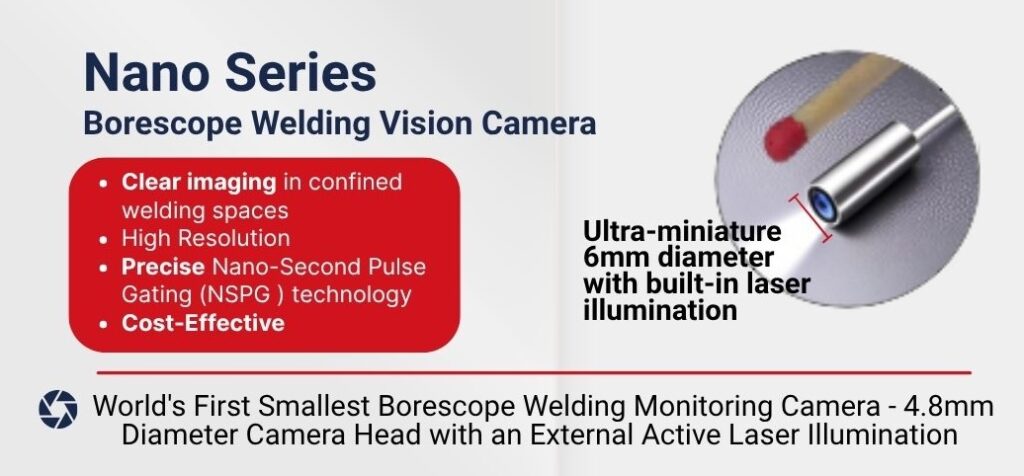
World’s First Smallest Borescope Welding Monitoring Camera
The modular Nano Series features a 4.8 mm diameter camera head with an external active laser illumination system, allowing weld monitoring in spaces that are inaccessible to conventional welding cameras.
Nano-Second Pulse Gating (NSPG)
The Nano Series incorporates Nano-Second Pulse Gating (NSPG) technology together with proprietary image-processing algorithms. This significantly reduces arc light interference, allowing operators to observe the weld pool more clearly during active welding.
Laser-Assisted Visibility
The separate active laser illumination source improves image quality in environments affected by smoke, dust, and difficult lighting conditions. The integrated version provides similar benefits through its built-in laser illumination system.
Full-Field HD Imaging
The camera delivers stable 800 × 600 resolution at 60 frames per second, producing full-field HD images without flicker during continuous weld monitoring.
Flexible Integration
Depending on the application, the Nano Series can be supplied with HDMI output, optional wireless or LAN connectivity, HDMI capture capability, and bendable snake tube assemblies for specialized installations.
Integrated Monitoring
The integrated control box includes a 5-inch HD display, allowing operators to monitor welds directly without requiring a separate computer. This simplifies installation while providing immediate visual feedback during welding.
Compatible with Multiple Welding Processes
The Nano Series is designed to support a wide range of welding applications rather than a single welding method. It can be integrated into:
- MMA welding
- TIG welding
- MIG/MAG welding
- Plasma welding
- Laser welding
- Electron beam welding
- Metal additive manufacturing
This flexibility allows the system to be used across both production environments and research applications where weld monitoring requirements vary.
Technical Specifications
| Parameter | Specification |
|---|---|
| Product Series | Nano Series Borescope Weld Monitoring Camera |
| Modular Camera | Ø4.8 mm × 16 mm imaging module |
| Integrated Camera | Ø6.0 mm camera head with built-in laser illumination |
| Resolution | 800 × 600 @ 60 fps |
| Sensor | 1/7.5-inch CMOS |
| Field of View | 20° × 14.5° |
| Working Distance | 30–300 mm (40–150 mm recommended) |
| Interface | HDMI 1.4 |
| Operating Temperature | -40°C to 85°C |
| Control Box | Integrated 5-inch HD display |
| Laser Safety | Class 3B |
Typical Applications
The Nano Series is used in industries where welding access is limited and continuous process visibility is important.
Nuclear Industry
Inspection of critical welds in confined environments while reducing operator exposure.
Aerospace Manufacturing
Monitoring welds inside compact structural components, fuel systems, and precision assemblies.
Automotive Manufacturing
Inspection of welds inside enclosed structural members and exhaust assemblies.
Shipbuilding
Observation of narrow joints and internal welds that are difficult to inspect using conventional cameras.
To explore additional welding vision systems, visit: https://mecaweldusa.com/products/
For more information about improving weld consistency, read:
Conclusion
Welding inside confined spaces requires monitoring equipment that can operate where conventional inspection systems cannot. The Nano Series addresses this need through two compact configurations: a 4.8 mm modular camera with external active laser illumination and an ultra-miniature 6 mm integrated camera with built-in laser illumination.
Combined with Nano-Second Pulse Gating technology, HD imaging, and flexible integration options, these systems provide reliable weld visibility in environments where direct observation is often impossible. By improving process visibility during welding, manufacturers can identify defects earlier, reduce unnecessary rework, and maintain consistent weld quality across demanding industrial applications.
FAQ
What makes the Nano Series different from conventional welding cameras?
The Nano Series is specifically designed for confined welding environments. Its modular version features a 4.8 mm diameter camera head with external active laser illumination, allowing installation in spaces where standard welding cameras cannot fit.
What is the difference between the modular and integrated Nano Series?
The modular version uses a separate external laser illumination source with a 4.8 mm imaging module, while the integrated version combines a 6 mm camera head and built-in laser illumination into a single compact assembly.
What is Nano-Second Pulse Gating (NSPG)?
NSPG is Mecaweld’s arc filtering technology that significantly reduces arc light interference, enabling clearer observation of the weld pool during active welding.
Which welding processes are compatible with the Nano Series?
The Nano Series supports MMA, TIG, MIG/MAG, plasma, laser, electron beam, and metal additive manufacturing applications.
Source
American Welding Society (AWS) – Welding processes, inspection, and quality guidance